After dictating an email, check the names, numbers and small words that carry its meaning. Then listen to the final version and make sure the recipient can see what you are asking for.
You can keep your normal voice. A useful message says what you mean and gives the other person a clear next step.
1. Check the people and places
Start with the recipient and any names inside the message. A name can look plausible and still belong to the wrong person. Compare it with the original email, contact record or document.
Check company names and unfamiliar place names separately. Use the spelling in the source when choosing between similar-looking suggestions.
2. Check dates, times and amounts
Read each number on its own. If you are replying about an appointment, look at the invitation while you check the date and time. Compare any price or quantity with the original figure.
Include the time zone when the recipient may be somewhere else. Replace “next Friday” with a specific date when it would make the arrangement clearer.
3. Look for a missing “not”
A short word can reverse the whole message. Pay particular attention to sentences containing “can,” “cannot,” “do,” “do not,” “before” and “after.”
Try this fictional editing example. The sender wants to tell Maya they cannot attend on 16 October at 10:30. They want to propose 17 October at 14:00 and send a two-page outline before the call.
Practice draft to check
Hi Mia,
I can join the call on 16 October at 10:30. Could we move it to 17 October at 4:00? I will send the two-page outline after the call.
Thanks,
Alex
Show the corrected message
Hi Maya,
I cannot join the call on 16 October at 10:30. Could we move it to 17 October at 14:00? I will send the two-page outline before the call.
Thanks,
Alex
The four corrections are Maya’s name, “cannot,” the proposed time of 14:00 and “before.” The question still asks Maya to agree to the new time.
When reviewing your own draft, compare these details with your notes and the arrangement you want to make.
4. Read it as the recipient
What should this person understand or do after reading the message?
If you ask to change a meeting, give a clear alternative. If you promise an attachment, attach it. If you need a reply, make the question easy to find.
“Could we move the call to 14:00?” gets to the request directly. Keep details that affect the decision and remove sentences that repeat the same point.
5. Listen to the final version
Use a read-aloud tool to listen while you follow the words on screen. Choose a comfortable pace and pause when something sounds different from what you meant.
After making a correction, listen to the changed sentence again. Compare names and figures with their source, then check the recipient and attachments before choosing Send.
A checklist to keep beside your draft
- Right person: recipient and names checked.
- Right details: dates, times, amounts and attachments checked.
- Right meaning: “not,” “before” and “after” checked.
- Clear next step: the question or request is easy to find.
- Final version: listened to after the last change.
Try the routine with a short everyday message first. You can use the reading and dictation tools you already have.
Reading and writing support in Chrome
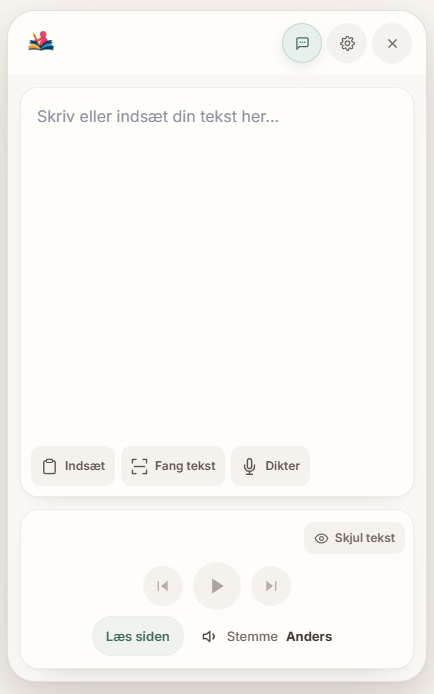
SkrivSikkert brings natural reading voices in many languages, speech-to-text and Chat alongside the page into Chrome. Explore the reading demonstration to see it in use.
All features are included within a 15,000-word free allowance each month.
Our website receives around 30,000 visitors from Denmark each month. Stefan Hühne’s work creating SkrivSikkert was recognised with Ordblindeprisen 2023, the Danish Dyslexia Association’s award.
Get extension